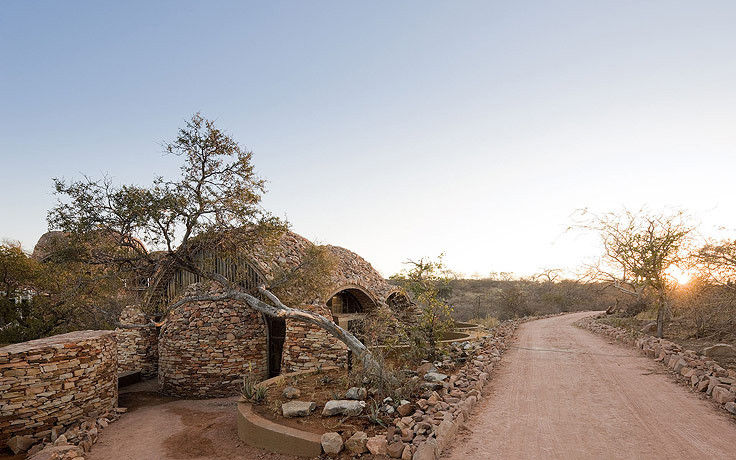
Mapungubwe Interpretation Centre: The Vaults of History Location: Limpopo, South Africa
At the confluence of the Limpopo and Shashe Rivers, where South Africa, Zimbabwe, and Botswana meet, lies the site of an ancient trading civilization. The Mapungubwe Interpretation Centre, designed by Peter Rich Architects, honors this history not by imposing a foreign structure, but by birthing one from the earth itself. Using 200,000 hand-pressed soil tiles, the building forms a series of organic, free-form vaults that mimic the surrounding hills, blending ancient technique with modern engineering.
A Building That Grew from the Ground
Mapungubwe is a UNESCO World Heritage site, a place of immense archaeological and ecological sensitivity. Building here required humility. Peter Rich Architects designed a complex that doesn't just sit on the landscape; it is of the landscape.
The building is set at the foot of a sandstone mesa. Visually, it is composed of hollow cairns, structures that evoke the traditional rock route-markers found across Southern African cultures. From a distance, the undulating, rock-clad forms seem to disappear into the bushveld, only revealing their dramatic scale as you approach.
The Vision: Symbiosis of Culture and Nature
The project’s agenda was dual: to present the area’s history and to empower its living community. The Route: Delicate walkways create a zigzagging ramped route through the complex, leading visitors through exhibition spaces and gently climbing the mesa. This path evokes the complex social interactions of the many cultures that have traversed this land for centuries. Social Construction: The construction process was a poverty-relief program. Unemployed local people were trained to manufacture the stabilized earth tiles and build the vaults. This transferred a valuable skill set to the community; many masons have since used these techniques to build their own homes in nearby villages.
Tectonics: The Return of the Timbrel Vault
The structural innovation here is world-renowned. Timbrel Vaulting: The architects revived a 600-year-old Mediterranean technique called "timbrel vaulting" (or Catalan vaulting). Instead of heavy concrete formwork, this method uses layers of thin tiles and fast-setting gypsum mortar to create lightweight, incredible strong shells that curve naturally. 200,000 Tiles: The vaults were built using 200,000 tiles made from soil pressed directly on site. This minimized transport costs and embodied carbon. Stone Cladding: The vaults are clad in loose stones from the site, giving them a rough, textured skin that camouflages the building against the rocky backdrop.
The Living Building: Cave-Like Comfort
The interior experience is primal and serene. Thermal Mass: The heavy earth structure acts as a thermal battery. The "cave-like" spaces moderate the extreme heat of the Limpopo valley, keeping the interiors cool during the day without the need for energy-intensive air conditioning. Light and Air: On approach, the thin arched edges of the vaults are exposed, soaring upwards to billow out of the earth. These openings channel breezes and frame specific views of the landscape, constantly orienting the visitor within the vastness of the park.
Data Sheet
Project: Mapungubwe Interpretation Centre
Location: Mapungubwe National Park, Limpopo, South Africa
Architect: Peter Rich Architects
Completion Year: 2009
Key Materials: Pressed Soil Tiles, Natural Stone
Construction Method: Timbrel Vaulting (Tile Vaulting)
Recognition: World Building of the Year (WAF 2009)
Photographs: Peter Rich Architects / Iwan Baan
Project Gallery


