RICA: The World’s First Climate-Positive Campus Location: Gashora, Rwanda
Set on a 3,400-acre peninsula, RICA is more than a university; it is a radical model for the future of the planet. Designed by MASS Design Group, the campus integrates agriculture, ecology, and education into a single "One Health" system. Built almost entirely from local earth, stone, and wood, and powered by the sun, it is the first campus in the world designed to be climate-positive, proving that large-scale infrastructure can heal rather than harm the environment.
Rwanda is the most densely populated country in continental Africa, where 80% of the population relies on farming, yet arable land is scarce. The Rwanda Institute for Conservation Agriculture (RICA) was founded to solve this paradox. It is an agricultural landscape, an ecological restoration effort, and an educational model rolled into one.
MASS Design Group did not just design a school; they designed a self-sustaining ecosystem. By treating the construction, the curriculum, and the conservation as a single entity, RICA demonstrates that food independence does not have to come at the cost of ecological health.
The Vision: One Health
The masterplan is shaped by the "One Health" philosophy, the understanding that the health of people, animals, and ecosystems is inextricably linked. The Living Laboratory: The campus dissolves the boundary between theory and practice. Every classroom extends into a farm, and every farm serves as a classroom.
The Curriculum Spine: Students progress through experiential learning, moving from smallholder plots to specialized enterprises like dairy and irrigation. These facilities are arranged along a central path, creating a social spine where academic knowledge meets the soil.
Tectonics: Radical Localization
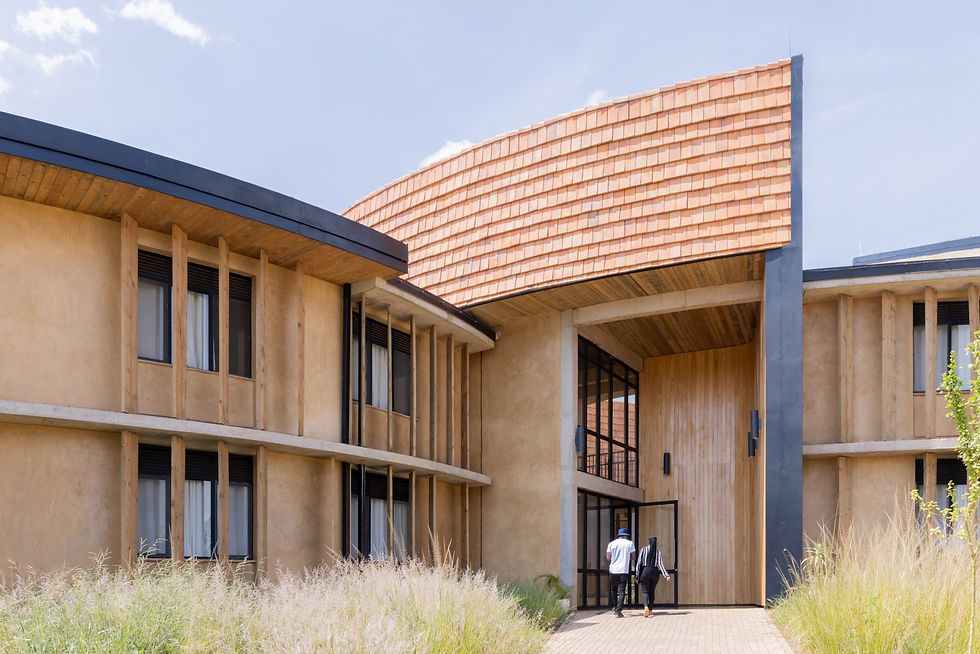
RICA is a manifesto for "provenance and performance." To achieve true sustainability, the team rejected imported materials in favor of what was beneath their feet. 96% Rwandan: An incredible 96% of construction materials were sourced within Rwanda. The 69 off-grid buildings are constructed using rammed earth, compressed stabilized earth blocks (CSEB), and locally quarried stone.
The Carbon Sink: By using low-cement earth mixes and regionally sourced softwoods for roofing, the project achieved an embodied carbon footprint 58% lower than the global average. It is designed to become fully climate-positive by 2044, offsetting all its construction carbon through landscape sequestration. Hand-Built: The ethos extends to the interior. MASS collaborated with over 85 local artisans to craft 3,300 pieces of custom furniture using native timber and weaving, injecting investment directly into the local economy.
The Landscape: Rewilding the Savanna
The site serves a dual purpose: productive farming and ecological rescue. Restoration: The peninsula, once degraded by deforestation, is being transformed. The landscape team propagated over one million plants to restore the native savanna woodland and wetlands.
Biodiversity as Infrastructure: Ecological corridors allow wildlife, including apex species and the grey-crowned crane, to move through the site. These natural systems regulate pests, improve soil quality, and filter water, proving that conservation is an essential partner to agriculture.
Data Sheet
Project: Rwanda Institute for Conservation Agriculture (RICA)
Location: Gashora, Bugesera District, Rwanda
Architect: MASS Design Group
Completion Year: 2023
Size: 3,400 acres (Campus: 20,000 m²)
Key Materials: Rammed Earth, Stone, Terracotta, Native Timber
Partners: Howard G. Buffett Foundation, Government of Rwanda
Sustainability Status: Off-grid, Climate Positive (projected 2044)
Photographs: Iwan Baan
Project Gallery


